Tuesday, November 12, 2013

Philosophy - German Idealism (Kant)


German Idealism- Kant

Immanuel Kant (1724-1804) - Critique of Pure Reason (1781), sought to explore the nature of the mind; to trace connections between its a priori nature and its a posteriori sense impressions in order to unite or synthesize these two aspects of mental activity.

Hume had negated the laws of causation as unverifiable by means of sense experience, reducing cause-effect relationships to the status of mere habitual assumptions.

Kant sought to explain the possibility of scientific knowledge, or more precisely, that relationship between cause and effect which enables the mind to grasp scientific truths.

Kant divided the process of attaining knowledge (his epistemology) into : (1) transcendental aesthetic   (2) transcendental analytic  (3) transcendental dialectic.

Kant analyzed the nature of the act of knowing, and concluded that both the mind endowed with a priori perceptions and the sensory impressions must unite to yield scientific (valid) knowledge.

Transcendental aesthetic - synthesizes sense experience through concepts of time and space; time and space are a priori, not real objects of the external world but ideal, creations of the mind.

Transcendental analytic - human understanding changes perceptions into conceptions or ideas possessing analytical unity; the mind now applies to experience certain categories of thought (a. quantity  b. quality  c.  relation  d. modality) without which the mind would be unable to think at all.  It enables us to think scientifically.

Hume had proved that cause-effect relations are not objectively real, do not exist in the outer world, they were merely habitual or customary assumptions applied to phenomena.

Kant tried to show that just as time and space were a priori categories of human understanding.

Transcendental dialectic - the human mind seeks complete knowledge, a coherent understanding of the entire universe; as such it tries to go beyond sense experience in order to discern ultimate reality.  Man’s experience provides him with phenomena only, yet his mind informs him that there is an ultimate ontological reality, a “thing-in-itself” which produces each phenomenon.

Kant postulated three kinds of reality (1) phenomena, sensory  (2) understanding  (3) ultimately real world (transcends our ability to sense therefore unknowable).

The ultimately real world becomes a reconstruction of the mind.

Antinomies result from the reason’s attempt to apply the categories of the understanding to the absolute, to the transcendental, whereas the categories are applicable only to empirical experience.

Antinomies - two contradictory inferences, correctly reasoned from principles, both of which are regarded as true.

Kant’s Ideals of reason (1) soul  (2) ultimate reality  (3)  God

- reason transcends the bounds of sensory experience.

Reason should be used as a controlling principle which sets up an ideal of perfect knowledge even though it is unprovable.

- supreme Being is for purely speculative reason a mere ideal, which completes and crowns the whole of human knowledge.

Kant stated that he had “limited all that we can know to mere phenomena” and had therefore “found it necessary to deny knowledge of God, freedom and immortality, in order to find a place for faith”.

Categorical imperative - moral laws which every person is bound to obey.

- we know what is morally right a priori, by intuition.

- right is right and mist be done even under the most extreme conditions.

- if the categorical imperative obligates the will to obey a moral command, it must necessarily follow that the individual has the power to carry out the obligation.

- duty represents the individuals obligation to obey the categorical imperative by choosing the morally right action.

- the categorical imperative is universal - allows no exceptions.

For Kant, self-determination, the autonomy of the rational will, is the indispensable condition of all morality.

Moral consciousness is a function of (1) freedom of the will  (2) immortality of the soul  (3) the existing Supreme Being - known through practical reason; they are necessary assumptions based upon the a priori moral law of the categorical imperative.

Pure practical reason  - the choice of conduct by the free will.

- speculative reason  (ie. science)  subordinate to practical reason (ie. ethics)

- advocated a World State, a federated republic of free states

Johann Gottlieb Fichte (1762-1814) - founder of the school of German Idealism (formulated a philosophy of the absolute), centred on the moral will as the activating principle of the world.

- regarded the fact of consciousness as the key to understanding reality (an object cannot exist unless a percipient experiences it).

Dialectical method - a logical system for comprehending the universe as a rational unit.

- as the basic principle of human knowledge, self-consciousness is the means of searching for the Absolute.

The fundamental “deed-act” is self consciousness, an absolute principle that can neither be proved or predetermined by specific causes.

- it is the sole and fundamental task of philosophy to clarify what is involved in this act of self analysis.

- reason utilises three rational principles - thesis, antithesis and synthesis to interpret the nature and goals of the universe (the dialectical process is endless).

thesis = person and his own consciousness (Ego)

antithesis = the object of his consciousness, sense phenomena (Non-Ego)

synthesis = unification of these two opposite into subject-object.

- Fichte’s dialectical method became the basis for Hegelian philosophy.

- the concept of Ego or self-consciousness

Fichte sought to synthesize Kant’s pure reason with practical reason (theory with practice).

- the entire phenomenal world is simply the stuff of duty structured in sensory form a the non-Ego which seeks to realise itself.

- the essence of things and their supreme principle is freedom

Friedrich Schelling (1775-1854) - nature is the visible form of spirit, and spirit is the invisible form of nature; the Ego and the world are two poles of one and the same reality; regarded phenomena as both ideal and real (transcendental idealism).

Absolute Reality consists of creative energy evolving through stages as mind and as matter and at present at its  highest level, namely self-consciousness.
- nature is but a material manifestation of reason, which in man, becomes conscious of itself.

- it was in the world of aesthetics (eg. art) that Schelling found a synthesis of the world of sense phenomenon with the work of mind, or man’s moral spirit.

- art supplants logic as the mode by which reason develops, art becomes the goal of reason.
God is the supreme creative artist, and the world is his artistic creation and highest expression.

Art is both the means and ends of education; it generates the fruits of science and morality (Schiller).

Friedrich Schleiermacher (1768-1834) - rather than Kant’s view that morality was the highest religious activity and Schiller who had accorded it to art, Schleiermacher set forth his own thesis that a mystical awareness of feeling is the highest religious activity.

God is “the identity of thought and Being,” the goal of all learning and knowledge.

- the highest religious activity has nothing to do with knowledge or ethics, rather it consists of communion with God, the feeling of absolute dependence upon God.

Wednesday, November 6, 2013

Philosophy - French Rationalism


French Rationalism

Locke influenced the philosophes of the French Enlightenment.

Deism - sought to formulate a rational religion based on Descartes’ concept of a mathematical universe, Newton’s laws of physics; Copernican theory of the planets and Locke’s view of experience as the only valid foundation of knowledge.

Voltaire, Francois Marie Arouet (1694-1778) - believed in a finite God with powers so limited that they could not eliminate evil, opposed religious institutions, fought for political liberty and individual freedom.

Dennis Diderot (1713-1784) - editor of the French Encyclopaedia.

Jean Jacques Rousseau (1712-1778) - advocated equal rights for all citizens under a democratic scheme of social contract, insisted upon the neutral goodness of human nature, appealed not to any intellectual basis for conduct, but to each persons feelings and sentiments.

Man is “born free, and everywhere he is found in chains,” civilisation is responsible.

- we must return to the simplicities of nature to determine the most natural mode of State.

Monday, November 4, 2013

Philosophy - British Empricists


British Empiricists

British Empiricists - no innate knowledge exists, whatever knowledge man possesses he has acquired after birth.

John Locke (1632-1704) - in the process of gaining knowledge, only the mental faculty is innate, actual knowledge itself is acquired.

- knowledge is imprinted on the mind by sensations, impressed upon the tabula rasa

Two kinds of experience (1) external (phenomena, senses)  (2) internal (reflection)

- simple ideas can be repeated, compared and united to form an infinite variety of complex ideas.

- primary qualities of objects are their real qualities  eg. solidity, motion, figure, etc.

- secondary qualities are those sensations that an object produces in us eg. sound, smell, taste.

Metaphysical agnostic - doctrine that the nature of ultimate reality cannot be proved or known.

Proof of God’s existence - since we are aware of the world as a complex of causes and powers, we must logically conclude that there is an original, supreme source of all causes and powers, namely Good.

- happiness is the greatest good, obedience to the moral law results in happiness.

George Berkeley (1685-1753) - founded objective immaterialism [the real universe is solely phenomenal and non material in nature], anglican bishop

- abstract ideas do not exist, essence  (reality) consists in its being perceived.

- a thing cannot exist in its own right independently of a mind, it requires a mind to provide the ground of its existence.

Solipsist - believes that he alone exists and that the external world is merely the subjective world of his own inner experiences (self-refuting doctrine).

- the world is real, for if it were not real, we could not experience it.

Doctrine of divine arbitrariness (1) the things we perceive are more vivid than those we merely imagine (2) the things we perceive do not obey our personal wills.

David Hume (1711-1776) - the only knowledge we can possess consists of a mere sequence of ideas, none of which can be proves to be true; a metaphysical skeptic.

Locke denied the existence of innate ideas; Berkeley denied the validity of any ideas abstracted from sensory experience.

- knowledge is restricted to mental states or experiences.

- denied the existence of ultimate reality (metaphysical nihilist), he asserted the existence only of the phenomena of sense (phenomenalist).

- he posited that there was no such thing as a true cause and effect relationship.

Hume was an ethical subjectivist (subscribed to the theory that morality consists of principles or values which the individual formulates for himself as a matter of personal opinion; he was also a social subjectivist inasmuch as he believed that moral values are based upon the opinions of a particular society and as such sentiment becomes the foundation of morality.

naive realism - the reality itself, the object, is exactly what it appears to the senses to be.

Watch Out For The Aggregate Disguise in Shale

The high depletion rates experienced in shale formations is being masked by the aggregate increase in gas production bought about by heightened levels of drilling. It reminds me of declining same store sales numbers being hidden by increased revenues from new store growth in the retail area.

I have been skeptical of the shale revolution from the beginning because I read a number of pieces highlighting the rapid well depletion rates early on. But that skepticism has had to take a backseat as the aggregate numbers have bullied any opposing view into submission. As with a large addressable market with plenty of room for new store growth (for a new concept), US shale formations provide a large addressable market with plenty of room for new wells.

P.S. From a USA Today article 11/4/13 "Sweet spots" — small areas with the highest yields. Hughes says these spots simply don't last long. Unless more wells are drilled, the Bakken shale of North Dakota and Montana loses 44% of its production after a year and the Eagle Ford shale of Texas, 34%. Most of the nation's major shale regions produce both oil and gas.

Friday, November 1, 2013

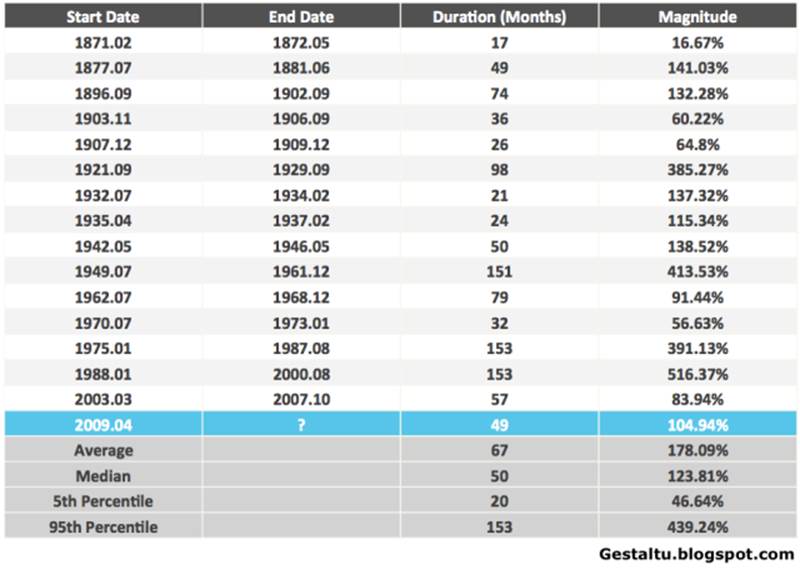
Long Cycles, Business Cycles, Market Cycles...Cycles, Cycles, Cycles

We are 54 months into the upcycle (in the market) with a 160% return off the bottom.

Here is an interesting set of reference points:

Philosophy - Continental Rationalism


Continental Rationalists

Scientific method - inductive method whereby the accumulation and interpretation of specific facts led to the discovery of a universal principle or law of nature.

- according to Bacon “knowledge is power”, man’s salvation is to be found in knowledge, through science nature may be brought under man’s control (conditions harmful to man, ameliorate).

- Bacon lost sight of the enormous significance that mathematics held for the symbolic understanding of the cosmic order (he had a passionate desire for utility and the practical application of knowledge).

Galileo applied mathematics to empirical facts about motion, synthesized Being and Becoming.

Rationalist philosophy: truth is derived from reason; reason is superior to and independent of sense experience; knowledge is deducible from a priori concepts.

Empiricism - knowledge depends upon experience

Descartes - founded analytic geometry, trained in scholastic philosophy, Catholic

Cartesian rules (1) never accept anything as true which is not known clearly and distinctly to be true (2) subdivide complex problems into many simpler parts   (3) arrange ideas in an orderly sequence from the simplest to the most complex  (4) take everything into account, omit no details.

Cartesian ethics  (1) obey the laws and customs of the nation, your religious faith and avoid extremes of behaviour  (2) stand by the convictions you have formed  (3) adapt yourself to the situation and the environment  (4) carefully choose your life work which will be best for you.

- he felt the revealed truths of theology transcend human reason.

cogito ergo sum - I think, therefore I am

- everything is subject to doubt except the fact of doubting itself; since doubting is an act of thinking it proves one’s existence; to doubt is to think and to think is to exist.

Innate idea - an idea which does not require sense experience as a basis for its validity.

Proof of God’s existence - (1) how can (a finite Being) conceive of God (the infinite) unless that idea was given to me by some substance  in reality infinite,  (2) The act of defining God as real and perfect implies an existent Being (God’s existence follows from his essence).

Cartesian metaphysical dualism - mind (thinking substance) and matter (occupation of space)

- CMD confronted serious difficulty in attempting to explain the interaction between two completely heterogeneous substances (mind and matter).

occasionalists: posited the theory that on those occasions when the mind interacts with the body, or vice versa, it is  a divine agency that brings about the changes.

Pascal’s religious wager - either you accept God’s existence or you don’t.  If you cast your lot on the side of God, then you have nothing to lose in this life and everything to gain in the life after; but if you deny God’s reality then you jeopardize yourself for all eternity should the case turn out that God exists [it is a 50/50 proposition].

Benedict Spinoza (1632-77) - Jewish philosopher; both human nature and the natural work are governed by fixed scientific laws (in the same way as geometrical figures); all true ideas are ultimately substance, nothing is external to God, eternal and infinite.

- mind and body are one and the same substance; substance is the ultimate ontological reality.

Psychophysical parallelism - whatever effects the mind also affects the body, et vice versa.

- man’s goal is toward an intellectual love of God.

Leibniz (1646-1716) - tried to build a bridge between scientific and theological methods of inquiry.

- the universe is teleological because it realises the goals set forth by God, but is mechanical because physical nature operates like a mechanism impelled and controlled by specific, efficient causes.

- philosophers should use words as accurately and logically as mathematicians use numbers.

- principle of sufficient reason “nothing happens without a reason”

- law of continuity “everything goes by steps in nature, nothing by leaps”

- space and time were phenomenal things and not genuine realities.

Panpsychism - all reality is based upon force or activity, also vitalism.
monad: denotes the force or activity constituting the essence of reality (substance)

Pre-established harmony: mind and body operate in perfect unison, without being connected

ontology = the study of ultimate Being or existence
natural theology - the study of the nature and existence of God

Christian Wolff (1679-1754) systematized the philosophy of Leibniz

Continental rationalism primary thesis was that knowledge is derived from reason, true knowledge is inborn (innate) because the intellect has at its disposal certain principles of reasoning.

Thursday, October 31, 2013

Back of the envelope energy calculations

I don't know the energy sector very well, but I come across interesting cost numbers every now and again.

I saw an article today that talked about the avg. Eagle Ford/Bakken shale/oil well producing about 400 barrels a day with decline rates of 50% per year. The article estimated the all-in cost of extraction/production was as high as $75/bbl.

I have heard the cost to drill a well varies between $5m-$10m (up from $1m to $3m less than 5 years ago).

Assuming the price of oil is $100/bbl and those estimates are about right, the economics are approximately:

Year 1: $100-$75 = $25/bbl margin x 400 x 365 = $3.65m profit
Year 2: $25/bbl x 200 x 365 = $1.825m profit
Year 3: $25/bbl x 100 x 365 = $912k
Year 4: $25/bbl x 50 x 365 = $456k
Year 5: $25/bbl x 25 x 365 = $228k
Total Profit Over 5 Years = $7.07m
Discounted at 12%
PV = $4.01m

Interesting.

P.S. From a USA Today article 11/4/13 "Tight oil development is still at an early stage, and the outlook is highly uncertain," says the Department of Energy's EIA in its Annual Energy Outlook 2013, adding its future will depend on how individual wells perform as well as their costs and the revenue they generate.

The reason: "sweet spots" — small areas with the highest yields. Hughes says these spots simply don't last long. Unless more wells are drilled, the Bakken shale of North Dakota and Montana loses 44% of its production after a year and the Eagle Ford shale of Texas, 34%. Most of the nation's major shale regions produce both oil and gas.